A bot has generated this blog entry based on the linked YouTube video. There are no intentions to steal the information or research from the original owner. This blog post is exclusively for "Educational Purposes Only," and I have no intention of earning, selling, or monetizing it. The main objective of this site is to share knowledge to as many people as possible. I strongly advise people to watch the original video for a better understanding.
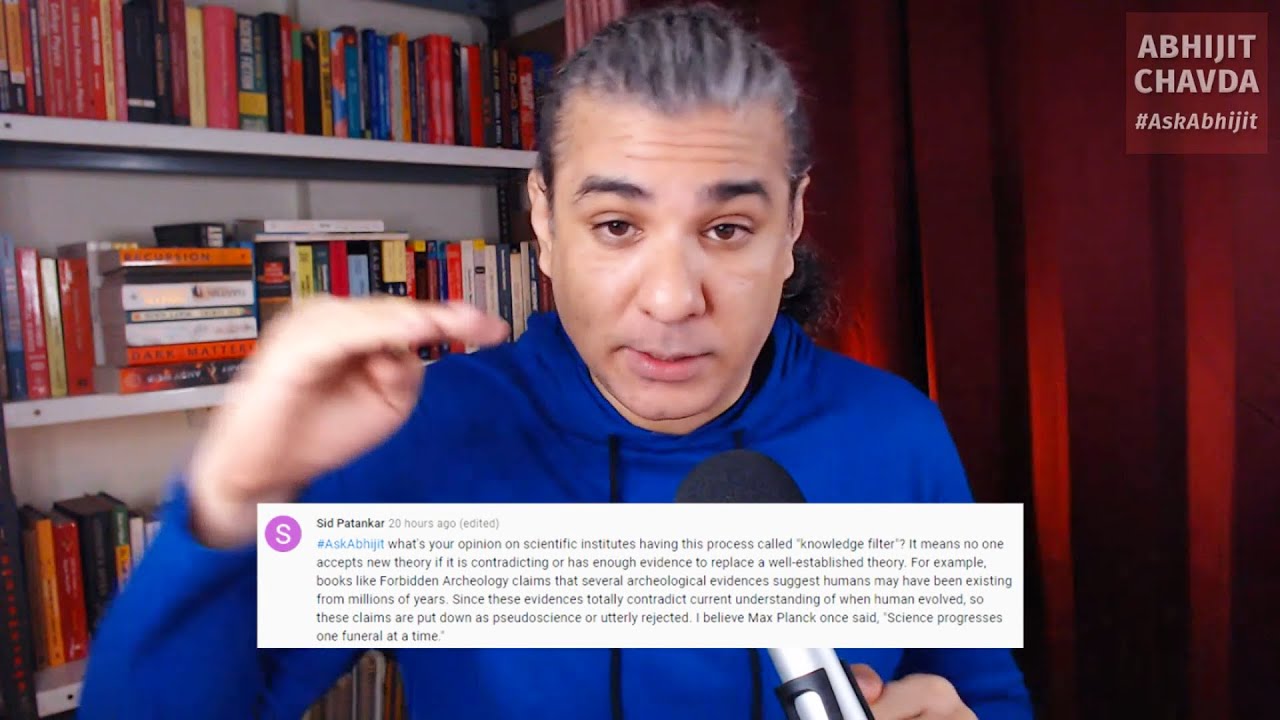
What'S your opinion on scientific institutes having this process called knowledge filter, it means no one accepts a new theory if it is contradicting or if it has enough evidence to replace a well-established theory. For example, books, like forbidden archaeology, claim that several archaeological evidences suggest humans may have existed for millions of years, since these evidence totally contradicts current understanding of when humans evolved. So these claims are put down as pseudoscience or utterly rejected. I believe max plan Max Planck. Once said, science progresses one funeral at a time. You are right that science has something has a number of filters. There is something called the scientific method and there is a very clear dividing line between science and whatever is not science.
Things such as philosophy and spirituality and religion, etc. these things are distinct from science. There is some overlap between science and philosophy, etc. now. It is true that there are very rigorous standards when it comes to new theories. Now some people claim that humans have been around for millions of years. I am aware that some people have this belief.
Some people have this claim, make these claims, but the evidence does not stand up to scientific scrutiny. It is very well known that the human chimpanzee divergence happened about two million years before today. The fossil evidence shows us that modern anatomically, modern humans evolved about a quarter million years ago about 250 000 years ago, and from the evidence that I have seen, I have not personally seen any credible evidence that humans have been around for millions of years in the Form that we are alive we are, we exist today, anatomically modern humans. There have been hominins and other species, other older species of proto-humans homo habits, Homo erectus, homo gender, Thales, they don't know Denison the flora flow Florence. Humans are the pi takers and many others, but these are primitive humans in the shape and form that we are in today have only been around for about a quarter million years at maximum. From what i, from the evidence that I have seen, I have not seen any evidence that overturns this understanding.
Now, what is pseudoscience is something that makes certain claims, but it is not scientifically rigorous enough. Science has certain standards and those standards have to be followed certain. If you make certain claims there have to be, there has to be, there has to be sufficient evidence that corroborates or validates these claims. Sometimes some people believe that something uh represents scientific evidence, but it may not be rigorous enough, so the thing is that only scientists can tell whether this evidence is scientifically acceptable or not. Now you do have a point that certain uh well all sciences are, to some extent subject to dogmatic thinking and group think and all that, for example, in the science of genetics, there is still, even today, this uh this notion they still are trying to propagate various Formulations of the Aryan invasion or migration theory, even though it is now more and more clear that that is entirely untrue. And yet you have these institutes in certain countries that are trying to still push Eurocentric notions.
So that is a misuse of science and they are trying to reject any theory that contradicts their favorite claims. So, yes, you are right that this does exist. Every scientific discipline is potentially falling prey to this. In physics, you have this string theory mafia. I mean the majority of theoretical physics.
Funding goes into string theory, which has not produced a single piece of concrete of verifiable predictions, not one. It'S not been able to give even one prediction that can be tested and a prediction that is falsifiable, and yet you have millions of dollars or billions of dollars being poured into string theory research every year. So that's the kind of dogmatic thinking group, think, etc. that does exist in science, so you are right to some extent and to some extent it is also true that lots of these claims are pseudoscientific in in. In reality, many people who have no understanding of science want to dabble in science and they come up with all these grandiose claims. So one needs to be very careful in science, the very first instinct of a scientist is skepticism, and that is how it should be.
The first instinct has to be if a new theory come is proposed. How do I disprove this theory? Because a theory has to be falsifiable so to uh, establish the validity or veracity of a theory? It is the job of every scientist who is faced with this theory to try and disprove it to try and falsify it. So that is the nature of science.
You have to try and falsify theories before you can be satisfied that they are true, so this uh, these standards are very much there and they do serve science because they enable the right kind of progress. Otherwise, we'll start believing all kinds of nonsense. So this is a complicated thing right, it's a complicated scenario. We do need all these standards. We don't need these filters, but sometimes many times these filters are misused. When you have these ganging up of certain people with certain beliefs or certain dogmas or certain agendas in science, and then they try and safeguard their citadel and they try to keep everybody else at bay, even when they know that they are wrong.
So it's true, so this works both ways and basically we need better management of science.